
Cyber & Electronic
Warfare
We harden critical defense infrastructure against present and future threats — specializing in anticipatory AI-driven defense, post-quantum cryptography, and cognitive electronic countermeasures.
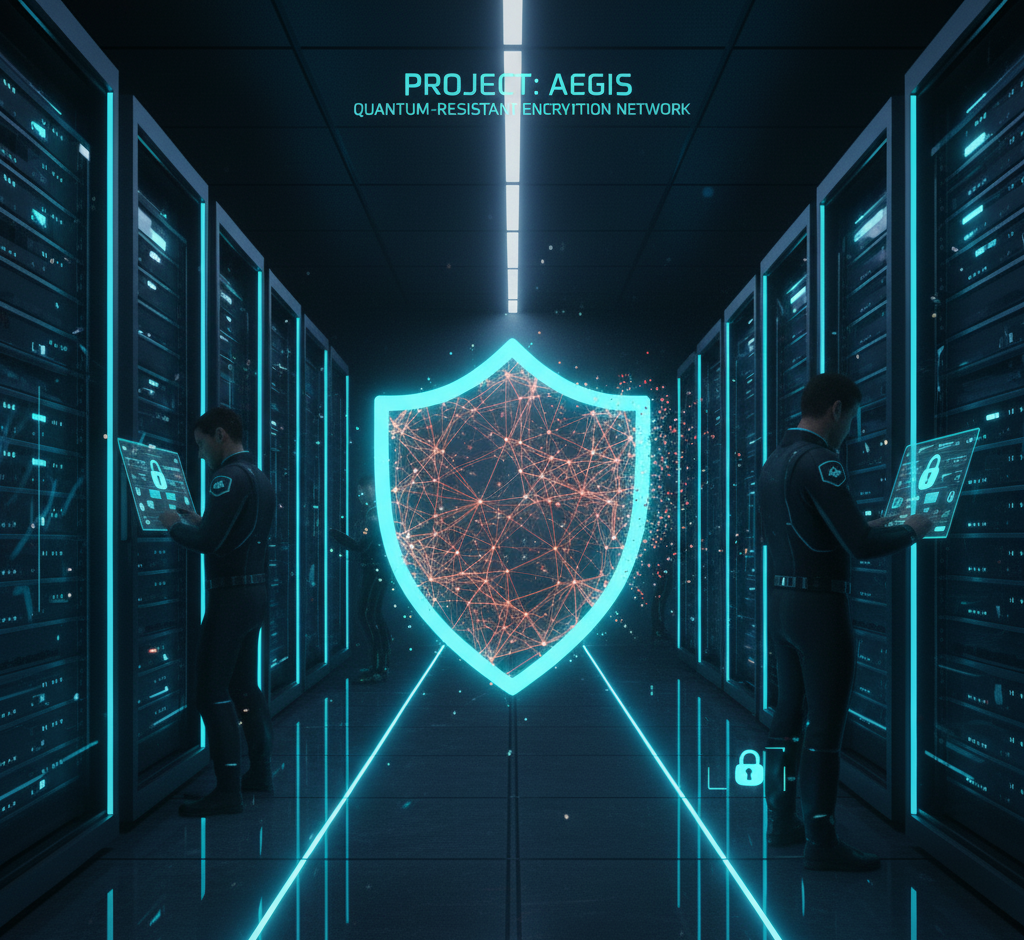 R&D Phase 3
Quantum-Resistant Encryption Network
AEGIS is a ground-up cryptographic architecture designed to protect Command & Control systems against both classical and quantum-computational attack vectors. Built on lattice-based post-quantum algorithms, it ensures C2 integrity remains uncompromised as adversary capability evolves.
AI Threat Hunting
Deep learning models analyzing network telemetry in real time — identifying zero-day exploits, lateral movement, and anomalous behavioral patterns before impact.
Electronic Countermeasures
Low-power, high-density RF jamming systems and sophisticated signal deception methods engineered for electronic battlefield dominance and spectrum denial.
Secure C2 Networks
Hardened command and control network architecture integrating encrypted datalinks, redundant routing, and compartmentalized access across distributed operational nodes.
Current public-key cryptography — RSA, ECC, Diffie-Hellman — will be broken by fault-tolerant quantum computers. The timeline is debated; the outcome is not.
State actors are already executing "harvest now, decrypt later" operations: intercepting encrypted traffic today with the expectation of decrypting it once quantum capability arrives. Data with long secrecy requirements — defense plans, intelligence, diplomatic communications — is already at risk.
AEGIS is built on lattice-based cryptographic primitives aligned with the NIST Post-Quantum Cryptography standardization framework. Our architecture is designed so that when quantum computers break conventional encryption, AEGIS-protected systems require zero migration — they're already hardened.
Quantum Computing
Decrypt Later Threat
Framework Aligned
When Quantum Arrives